
Key Takeaways
Before placing a bulk order, do not evaluate a flexible solar panel supplier by price alone. Review product fit, technical evidence, sample-to-production consistency, and supply capability together.
A reliable supplier should be able to explain what can be customized, which documents apply to the selected model, how samples are validated, and what must be confirmed before production.
A product catalog does not prove project fit. A test report does not automatically apply to every model or structure. A successful sample does not replace production and quality-control review.
A flexible solar panel may look suitable on a product page but still create problems after the order is placed.
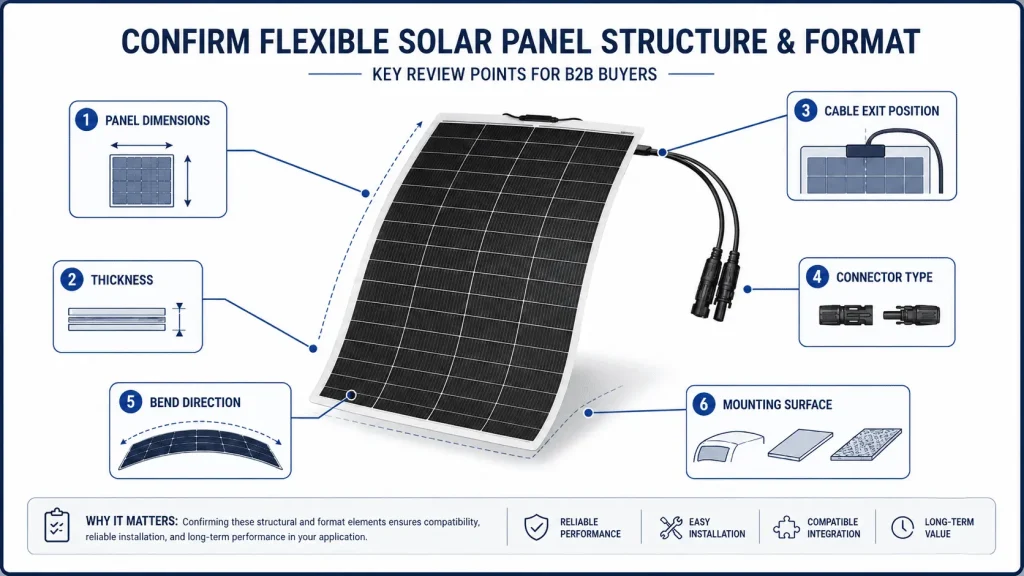
Common issues include a panel that does not fit the installation area, a cable exit in the wrong position, an incompatible connector, a sample that differs from the bulk-production version, or a test report that does not cover the selected model.
A lower quote can become expensive if the buyer later has to redesign the panel, replace unsuitable packaging, or resolve missing documentation.
Why Supplier Evaluation Matters Before a Bulk Order
Supplier evaluation should happen before the final quotation is approved. For OEM buyers, it should happen before a sample is treated as a production reference.
The review should cover four questions:
- Can the supplier build the required panel format?
- Can the supplier provide documents that match the product?
- Can the approved sample be reproduced at volume?
- Can the supplier support packaging, delivery, and after-sales requirements?
Define Your Project Requirements Before Comparing Suppliers
A clear application brief gives the supplier enough information to prepare a meaningful quotation.
Product Requirements
- Panel length and width
- Target wattage
- Operating voltage
- Current range
- Cell technology
- Surface material
- Backing structure
- Cable exit position
- Connector type
- Cable length
- Mounting method
- Target operating environment
Application Requirements
The same flexible panel may be evaluated differently for an RV roof, yacht deck, curved commercial roof, balcony system, portable power system, off-grid device, or commercial vehicle.
A yacht project may focus on salt-air exposure and cable routing. An RV project may focus on weight, roof space, and heat. A distributor may focus on packaging, labeling, and repeatable product options.
Purchasing Requirements
- Target market
- Estimated order volume
- Sample quantity
- Packaging requirements
- Private-label requirements
- Required technical documents
- Expected delivery window
- Replacement and after-sales expectations
Check Whether the Supplier Can Support Your Panel Format
Supplier capability should be reviewed in three areas: dimensions, electrical design, and construction.
Dimensions and Layout
Ask whether the supplier can support non-standard dimensions, narrow or elongated panels, repeated custom sizes, different cell layouts, limited roof or deck space, and clearance around other equipment.
The supplier should be able to work from a drawing or a defined dimension table. Verbal descriptions are rarely enough for a repeatable production order.
Electrical Design
Confirm how the supplier handles voltage range, current range, cell configuration, series and parallel layout, cable routing, junction box position, connector selection, cable exit, and back-exit design.
A panel can have the correct wattage and still be unsuitable for the controller or battery architecture. Electrical compatibility needs to be reviewed with the rest of the system.
For projects involving custom size, voltage, cable position, and mounting requirements, buyers can review Sungold’s custom solar panel solutions as a reference for the information required.
Structure and Materials
The buyer should ask about ETFE, PET, or other surface options, flexible or lightweight construction, backing material, encapsulation structure, adhesive or mounting compatibility, bend requirements, outdoor exposure, and the thermal environment.
The supplier may not disclose every internal material detail. The buyer should still receive enough information to understand the construction, application boundary, and documentation scope.
Review Technical Documents, Not Just the Product Page
A supplier evaluation should include a document review.
| Document | What It Helps Confirm |
|---|---|
| Datasheet | Electrical and physical specifications |
| Test report | Performance under a defined test scope |
| Certificate | Certification scope and model information |
| Installation guide | Mounting, wiring, and use conditions |
| Warranty document | Warranty boundary and conditions |
| Packaging specification | Transport and handling requirements |
A document is useful only when its model, structure, test scope, and target market match the product under review.
IEC 61215
IEC 61215 relates to photovoltaic module design qualification and type approval. The test procedures are intended to assess whether a module can withstand prolonged outdoor exposure under defined conditions. Flexible products should not automatically be described as covered without checking their actual construction and certification scope.
For a practical document-review path, see Sungold’s flexible solar panel certification guide.
IEC 61730
IEC 61730 addresses photovoltaic module safety. IEC 61730-1 covers construction requirements for safe electrical and mechanical operation. IEC 61730-2 covers safety testing.
This distinction matters for customized products. A change in material, structure, cable design, or another construction detail may require additional evaluation.
IEC 62941 and Manufacturing Quality
IEC 62941 provides a framework for quality control in PV module manufacturing. It addresses product design, manufacturing processes, and the selection and control of materials used in qualified PV modules.
It does not mean that every supplier using the standard has the same production capability. Ask how the supplier controls the specific product and production batch.
Modified Construction
If the flexible panel changes after an original assessment, ask whether the change affects the qualification scope. IEC TS 62915 provides guidance for retesting PV modules after modifications to their original design or construction.
The practical question is: does the certificate cover the exact structure being quoted, or only a similar product?
Ask How Samples Are Made and Validated
A sample should be treated as a technical reference, not just a visual check.
Before approving a sample, confirm the sample design reference, dimensions, material structure, cell type, cable and connector details, sample timing, electrical test method, appearance inspection, mounting check, and revision number.
Project Brief -> Drawing Confirmation -> Sample Production -> Electrical and Appearance Review -> Installation Check -> Revision -> Pilot Order -> Bulk Production
Ask whether the sample uses the same materials and production method intended for the bulk order.
A sample can pass a visual inspection and still leave important questions unanswered:
- Is the cable position correct?
- Is the panel voltage compatible?
- Is the mounting method suitable?
- Does the surface material match the quotation?
- Are the dimensions within the agreed tolerance?
- Will the same structure be used in production?
Written acceptance criteria reduce later disputes.
Check Production Consistency Before Bulk Orders
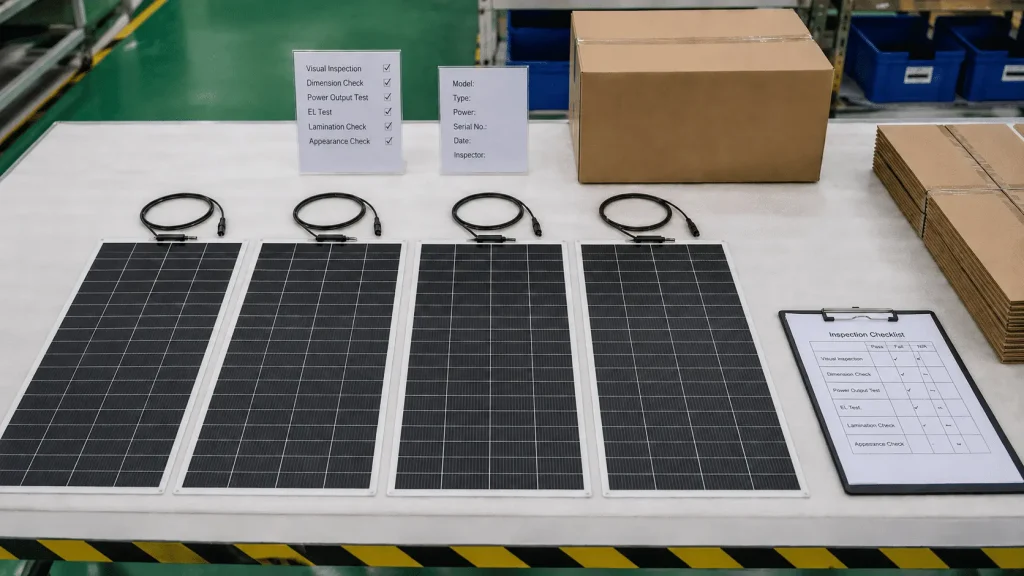
A factory photo does not show whether the supplier can repeat the same product at volume.
| Area | Buyer Question |
|---|---|
| Materials | Are key materials controlled by specification and batch? |
| Dimensions | How are length, width, and cable position checked? |
| Electrical output | What tests are performed before shipment? |
| Appearance | How are wrinkles, bubbles, scratches, and edge defects handled? |
| Wiring | How are cable length and connector type verified? |
| Traceability | Can the batch be linked to production and inspection records? |
The more customized the panel, the more important revision control becomes. A supplier should be able to identify which drawing, material version, and electrical design were used for a particular order.
Review Packaging, Labeling and Private-Label Readiness
Distributors and importers often focus on the panel specification and review packaging too late.
Confirm individual packaging, carton design, protection for flexible panels, product labels, product identification, installation instructions, barcode or serial number, private-label logo, language requirements, shipping marks, and spare parts or accessories.
Packaging is part of the product package. It affects transport damage, warehouse handling, customer experience, and after-sales support.
The same principle applies to documentation. If the target market requires specific languages or user instructions, confirm that requirement before production rather than after the shipment is ready.
Confirm Commercial Terms Case by Case
Bulk buyers usually need written confirmation of MOQ, sample cost, sample timing, production lead time, payment terms, shipping terms, packaging cost, private-label cost, replacement policy, warranty terms, and document preparation.
These terms depend on product structure, order quantity, packaging, documentation, and target market. Confirm them in the quotation rather than assuming them from a general product page or an earlier order.
A useful quotation should identify the product model or project reference, approved dimensions, electrical parameters, surface and backing structure, cable and connector details, packaging scope, document scope, commercial assumptions, and validity period.
Red Flags When Comparing Flexible Solar Panel Suppliers
Be careful when a supplier:
- Provides only product images without a datasheet.
- Cannot identify the quoted model.
- Sends a test report that does not match the product structure.
- Uses broad certification language without scope details.
- Cannot explain the material structure.
- Does not ask about the installation environment.
- Cannot confirm cable, connector, or dimension customization.
- Treats the sample and bulk order as separate designs.
- Provides a low price without defining packaging and documentation.
- Has no clear process for design changes or production revisions.
These signs do not automatically prove that a supplier is unsuitable. They do indicate that more evidence is needed before moving forward.
A Flexible Solar Panel Supplier Evaluation Scorecard
| Evaluation Area | What to Verify | Evidence to Request |
|---|---|---|
| Product fit | Size, voltage, surface, cable design | Datasheet and drawing |
| Material structure | Surface film, backing, encapsulation | Approved material description |
| Certification | Model and scope | Certificate or test report |
| Sample validation | Sample-to-production consistency | Sample record and acceptance criteria |
| Quality control | Electrical and appearance checks | Inspection record |
| Customization | Size, wiring, connector, label | Project specification |
| Supply readiness | MOQ, lead time, packaging | Written quotation |
| After-sales | Warranty and replacement boundary | Warranty document |
This scorecard helps buyers compare suppliers using the same questions. It also makes missing information easier to identify.
How Sungold Can Support Flexible Solar Panel Projects
For buyers comparing flexible solar panel suppliers, Sungold can review the project around panel size, voltage, surface material, cable position, installation surface, application environment, documentation, and sampling requirements.
For flexible RV, marine, curved-roof, and other weight-sensitive projects, buyers can review the PA219 flexible solar panel as one product path.
The final product choice still depends on the project drawing, system voltage, mounting method, target market, and required documents.
Before requesting a quotation, prepare a panel drawing, target wattage, voltage requirement, application photos, cable and connector requirements, target market, sample quantity, estimated order volume, and packaging requirements.
Cable position, cable length, and connector requirements can often be reviewed during project engineering, but the available options depend on the panel structure and production process.
Product scope, certification, MOQ, lead time, and warranty terms should be confirmed for each project.
FAQ
What documents should I request before placing a bulk solar panel order?
Start with the datasheet, product drawing, applicable test reports, certification information, installation instructions, packaging details, and warranty terms. Confirm that the documents match the selected model and construction.
How can I confirm that a test report applies to the panel I am buying?
Compare the model number, dimensions, material structure, cell technology, electrical parameters, and issuing organization. If the quoted product has been modified, ask whether the change affects the original test or certification scope.
Can a flexible solar panel supplier customize the cable position and connector type?
Cable position, cable length, and connector requirements can often be reviewed during project engineering, but the available options depend on the panel structure and production process. Confirm these details on the drawing before approving a sample.
Should I approve a sample before placing a bulk order?
A sample is strongly recommended when the panel has a custom size, special cable design, private-label requirement, or application-specific structure. Check it against written electrical, dimensional, appearance, and installation criteria.
What should distributors check besides panel wattage?
Distributors should also review size, voltage, material, packaging, documentation, mounting guidance, sample consistency, after-sales support, MOQ, and lead time. Wattage is only one part of the product package.
Final Thoughts
A flexible solar panel supplier should be evaluated as a project partner, not only as a source of low-cost panels.
Start with the project requirements. Then review product fit, technical evidence, sample quality, production control, packaging, and commercial terms.
For the buyer, the practical test is whether the supplier can control the approved design from sample production through repeat orders.
For distributors, OEM buyers, and system brands, this process reduces surprises before bulk orders and creates a clearer path from product inquiry to long-term supply.
Source NotesIEC 61215-2:2021 covers design qualification and type approval test procedures for terrestrial photovoltaic modules: IEC 61215-2.
IEC 61730-1 addresses photovoltaic module construction requirements, while IEC 61730-2 addresses safety testing: IEC 61730-1 and IEC 61730-2.
IEC 62941 provides manufacturing quality system guidance for PV modules: IEC 62941. IEC TS 62915 provides guidance on retesting after modifications to PV module construction: IEC TS 62915.