
The solar frontier has shifted from the barren desert to the unforgiving salt spray of the open ocean. Offshore Floating PV (FPV) Renewables represent one of the most promising but technically demanding segments of the sector. However, the sea is a corrosive animal. For solar assets deployed in marine environments, the primary risk is not performance loss from heat – it’s structural breakdown due to galvanic and chemical corrosion.
But Singold SolarWe have built our offshore series to thrive where others fail. Our expertise is the foundation of our reliability. Corrosion resistance of solar framesvalidated by the industry’s most fearsome benchmark:
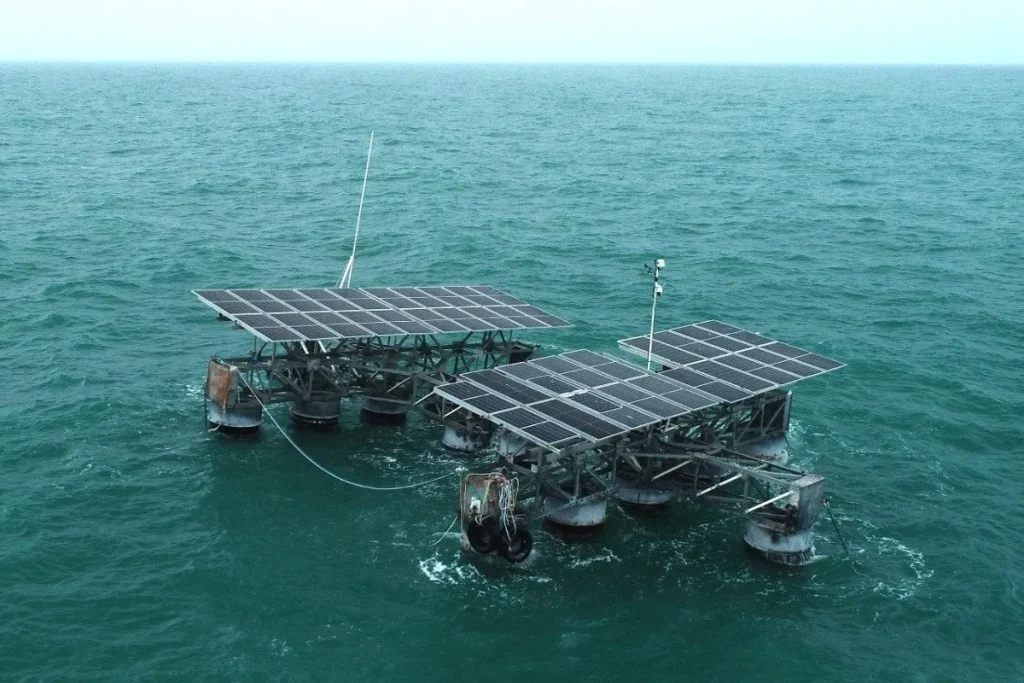
Sea hazard: Why offshore floating PV is a “material killer”.
In exotic environments, solar frames face a “triple threat” of degradation:
Salt sprays and aerosols: Microscopic salt particles freeze on the frame, attracting moisture and forming a highly conductive electrolyte that accelerates electrochemical corrosion.
C6 Corrosivity Category: More saline coastal and oceanic areas are classified as C5-M or C6 environments. Standard anodized aluminum frames, designed for indoor use, can show pitting and structural weakness within months.
Zinc Corrosion: The interaction between the aluminum frame, stainless steel mounting hardware, and salt water creates a battery-like effect that “eats away” the soft metal (aluminum) if not properly insulated.
To avoid these situations, Corrosion resistance of solar frames in offshore floating PV Must be integrated into the molecular structure of the material, not just added as a top coat.
Decoding IEC 61701 Level 6: The “Gold Standard” of Salt Mist Testing
Most solar panels claim “salt spray resistance”, but Level 6 The designation is what separates consumer grade hardware from industrial marine grade equipment.
What is Level 6 Testing?
Unlike levels 1 through 5, which simulate inland or mild coastal conditions, Level 6 There is an “extreme marine environment” test. This includes:
Cycling Stress: The modules are subjected to repeated salt spray followed by high humidity storage (40°C, 93% RH).
Long term: The exam lasts. 56 days of continuous cycling.
Structural and Electrical Audit: At the end of the test, the panel should show zero noticeable corrosion on the frame, no insulation breakdown, and less than 5% power loss.
Benefit of Singold: Our frames don’t just “pass” Level 6; They emerge with zero structural pitting. This ensures that the mechanical integrity of the floating array is maintained for its 25-year design life, preventing costly frame failures that could lead to panel sinking or short-circuiting.
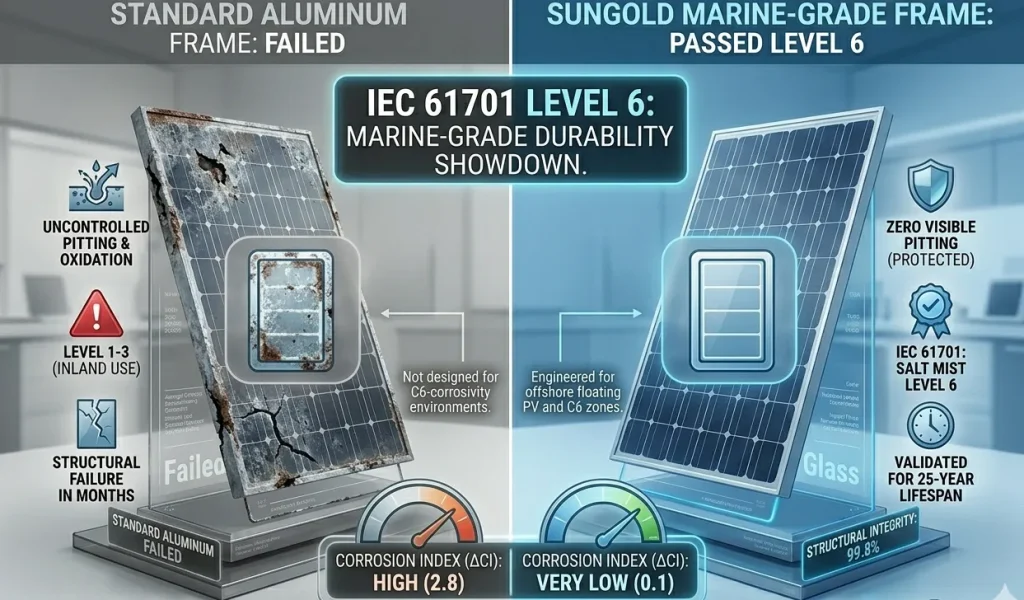
Frame engineering: Marine grade aluminum and advanced anodization
The Secret of Singold Corrosion resistance of solar frames lies in our special metallurgical process.
6000 Series High Strength Aluminum
We use a special 6000 series aluminum alloy, known for its high strength-to-weight ratio and inherent resistance to marine corrosion.
Double layer anodization (20μm+ thickness)
While standard panels have a thin 10-12μm anodic film, Singold’s offshore series uses one. The double layer anodization process is more than 20μm.. This creates a dense, non-porous alumina (A12O3) barrier that is impervious to chloride ion penetration.
Hydrophobic edge sealing
In offshore FPV, the point where the glass meets the frame is a critical hazard. We use a special marine-grade silicone sealant that has a high “salt kill” resistance, ensuring that salt water cannot collect in the frame grooves and initiate hidden corrosion.
Real-world applications: from salt farms to the deep sea
High Corrosion resistance of solar frames in offshore floating PV Singold allows modules to be deployed in scenarios previously thought impossible:
Floating arrays near shore: Powering desalination plants where salt concentrations are at their peak.
Integration of Aquaculture: Providing clean energy for offshore fish farms, where the frames are constantly stressed by wave action.
Remote Island Microgrids: Replacing diesel generators in tropical islands where the entire land mass is a high salinity area.
Frequently Asked Questions: Protecting Your Marine Investment
Q: Does salt build-up on the frame affect the solar cells?
A: Accumulate salt The frame leads to structural failure. But salt Glass leads to loss of electricity. Singold frames prevent structural deterioration, while our anti-soiling glass coatings help rain wash away salt crystals to maintain energy harvesting.
Q: Can I use standard mounting rails with Singold Offshore Panels?
A: We strongly recommend using a marine grade (316L) stainless steel or special coated aluminum mounting system to prevent galvanic corrosion at the contact points.
Q: Is IEC 61701 Level 6 required for indoor RV use?
A: While the Level 6 is “over-engineered” for the desert, it is highly recommended for RVers who frequently travel along coastal highways or park near the ocean. This ensures that your investment never develops the typical “white rust” in salty air.
The result: the anchor of your offshore energy strategy
In the world of Offshore floating PVthe frame is the anchor of your investment. Without the aristocracy Corrosion resistanceEven the most efficient cell technology is useless once the structure fails.
By securing IEC 61701 Level 6 CertificationSingold Solar provides the “Marine-Grade Guarantee” that the industry demands. We don’t just make panels. We build marine assets that are designed to withstand the harshest elements on earth.