
Comparing solar panel quotes from different suppliers is not a simple price exercise. This guide explains how to compare solar panel quotes from different suppliers without treating every quotation as an equivalent offer. The lowest unit price is rarely enough to make a sound decision. First check whether the quotations describe the same product, the same documentation scope, the same delivery basis, and the same level of customization.
For distributors, importers, OEM/ODM buyers, and project teams, the practical question is not simply “Which supplier is cheaper?” It is “Which quotation gives us a comparable product, a usable delivery plan, and evidence we can verify?”
In a real RFQ, the spreadsheet is usually the last step. The more important work happens earlier, when engineering requirements are translated into a quote that purchasing, quality, logistics, and sales teams can all understand. A useful comparison therefore tests the quotation itself, not only the supplier’s headline price.
Key Takeaways
- Compare quotations against one written technical brief. Do not compare price per watt when the panel format, materials, cable design, or documents are different.
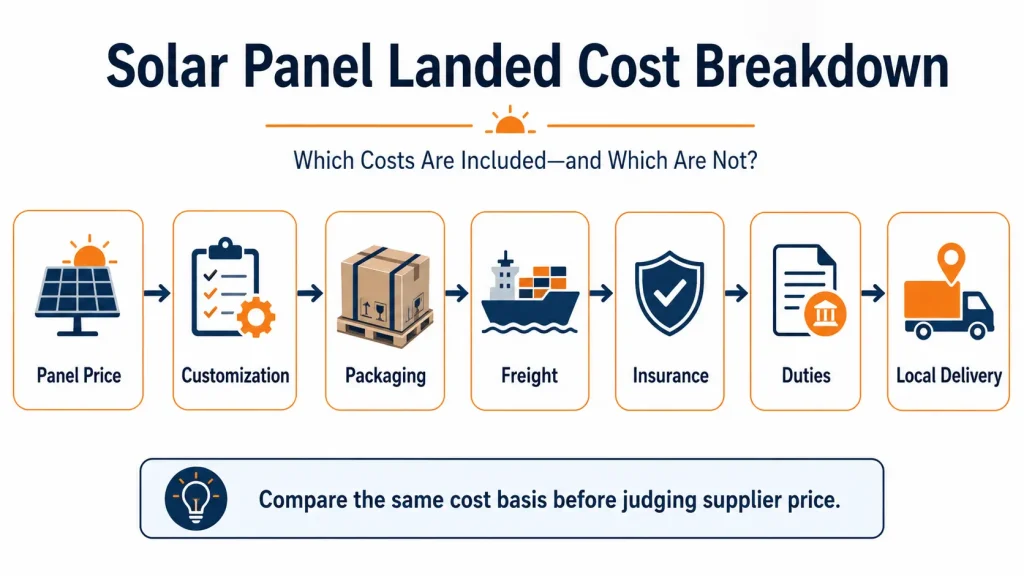
- Separate product price, customization work, testing, packaging, freight, insurance, duties, and local delivery before judging total cost.
- Ask for certificate and test-report references that match the exact model or construction under review.
- Review sample approval, production consistency, change control, packaging, and after-sales documents before placing a bulk order.
- Treat MOQ, lead time, warranty, and payment terms as project-specific commercial items that must be confirmed in the quotation and order documents.
What Should a Solar Panel Quote Include?
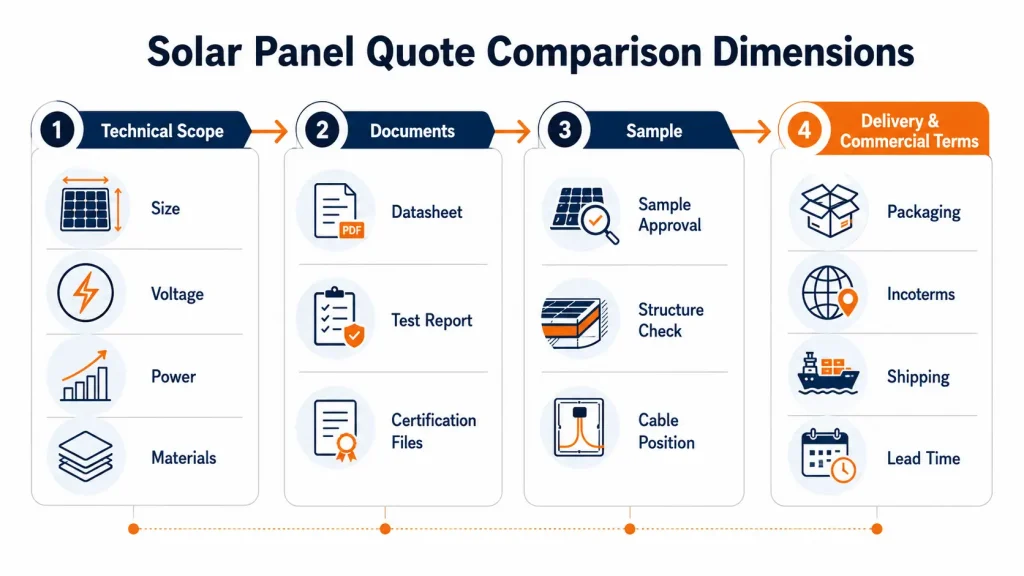
A useful quotation should allow another person on the buying team to understand exactly what is being offered. At minimum, ask the supplier to identify the product model or project reference, rated output, electrical configuration, and dimensions. The quotation should also state the surface material, cable and connector arrangement, packaging basis, delivery term, and validity period.
For a standard rigid module, a basic datasheet may cover much of the technical scope. For a flexible or customized panel, the quotation normally needs more detail. Surface film, laminate construction, bend or mounting requirements, cable exit position, connector type, and project drawings can materially affect the product being compared.
If two suppliers use the same wattage but different dimensions, surface materials, cable layouts, or mounting assumptions, they are not offering the same item.
How Can Buyers Create a Fair Comparison?
Send the same input to each supplier. This is the simplest way to prevent a low quote from looking better because it excludes requirements that another supplier included.
| Requirement area | Information to standardize | Why it matters |
|---|---|---|
| Application | RV, marine, balcony, vehicle, roof, portable, or off-grid project | The installation environment changes the design review |
| Module format | Rigid, flexible, lightweight, folding, custom shape, or standard size | Format affects mounting, packaging, and handling |
| Electrical output | Rated power target, operating voltage, current, and connection layout | The panel must match the next system component |
| Construction | Cell technology, front surface, back layer, laminate, frame, or junction box | Materials and construction affect the quotation scope |
| Mechanical details | Dimensions, thickness, weight, bend direction, mounting surface, and cable exit | These details are central to non-standard projects |
| Documentation | Datasheet, drawings, test reports, certificates, manual, and labels | Documents may be required for import, sales, or project approval |
| Commercial scope | Quantity, sample requirement, packaging, private label, delivery place, and trade term | These items change the actual procurement cost |
For flexible solar panel projects, Sungold’s custom solar panel solution can be used as a starting point for organizing dimensions, electrical requirements, cable positions, materials, and application information before quotation.
Which Costs Are Included—and Which Are Not?
A quotation can look inexpensive because several requirements are missing or treated as optional. Ask each supplier to show the following items separately where relevant:
- Base panel or module price
- Custom tooling, engineering, or drawing work
- Sample and prototype charges
- Testing or document preparation
- Packaging, labels, and private-label materials
- Spare parts, connectors, or cable changes
- Freight, insurance, duties, and local delivery
- Payment terms and quotation validity
This does not mean every project will contain every charge. The purpose is to make the scope visible. A supplier that lists a complete project scope may appear more expensive than one that has not included testing, custom packaging, or delivery-related costs.
When Is Price per Watt Useful?
Price per watt can be a useful screening metric for comparable products. It is not a complete procurement metric.
Before using it, confirm that the quotations share the same:
- Rated power basis and test conditions
- Module dimensions and active area
- Cell technology and electrical layout
- Surface and laminate construction
- Cable, connector, and junction-box configuration
- Packaging and delivery basis
- Certification and documentation scope
For example, a customized lightweight panel and a standard rigid panel should not be ranked only by dollars per watt. Their weight, mounting method, usable area, packaging, and installation requirements may serve different project objectives.
The same issue appears when two suppliers quote panels for the same vehicle or roof. One quote may include a custom cable exit and drawing approval. The other may assume a standard cable position. The wattage may match, but the engineering scope does not.
Do the Certificates Match the Quoted Panel?
Ask the supplier to identify which model, construction, and revision each document covers. A certificate logo or a general statement such as “IEC certified” is not enough for a technical comparison.
IEC 61215 addresses PV module design qualification and type approval. IEC 61730-1 covers construction requirements, while IEC 61730-2 covers safety testing requirements. These standards address different parts of the qualification process. Buyers should request the relevant certificate and report set instead of treating one reference as a substitute for all others.
For manufacturing consistency, IEC 62941 provides a quality-system framework for PV module manufacturing. It should not be interpreted as proof that every model or every customized construction has the same certification scope.
When comparing quotations, request:
- The certificate or evaluation reference.
- The exact model or construction covered.
- The report revision and issuing body.
- Any limitations, exclusions, or conditions of use.
- Confirmation of whether a changed material, size, cell layout, or laminate requires additional evaluation.
Sungold’s Flexible Solar Panel Certification Guide provides a related document-review path for ETFE, fire-rating boundaries, salt mist, ammonia, mechanical-load, and model-specific test-report questions.
How Should the Sample Become the Production Reference?
The sample is not only a product demonstration. It is the reference against which the buyer can review the first production batch.
Ask each supplier to explain:
- What sample information will be recorded?
- Which dimensions and electrical values will be checked?
- How will cable position, connector type, labels, and packaging be approved?
- How are material or design changes communicated after approval?
- What happens if the production unit differs from the approved sample?
- Which quality records can be provided for the shipment?
For a custom panel, a clear approval path is often more valuable than a short initial quote. It reduces the chance that the buyer approves one configuration and receives another because an unrecorded change was made during production.
What Does the Quoted Lead Time Actually Cover?
“Lead time” can refer to different stages. Ask the supplier to separate:
- Technical review and quotation
- Drawing or specification confirmation
- Sample production
- Sample testing and approval
- Material preparation
- Pilot or first production run
- Bulk production
- Packaging and dispatch
The actual schedule depends on the product format, customization level, materials, testing scope, order quantity, and production plan. A supplier should confirm the applicable schedule for the selected project instead of providing a general number that may apply to another product.
Does the Delivery Term Show the Real Cost?
FOB, CIF, EXW, DAP, and other trade terms do not represent the same cost or risk position. The quotation should state the named place and the applicable Incoterms rule and version.
The International Chamber of Commerce’s Incoterms 2020 rules allocate responsibilities, costs, and risks between buyer and seller. In practice, a buyer should confirm:
- Who arranges export clearance?
- Who pays for main transport?
- Is insurance included, and at what level?
- Where does transport risk transfer?
- Who handles import clearance, duties, taxes, and local delivery?
- Is the destination a port, warehouse, terminal, or final address?
A CIF quotation and a DDP quotation cannot be compared as if they were the same delivered price. Prepare a landed-cost table with the same destination and assumptions for every supplier.
What Makes the Quote Ready for Resale or Deployment?
Packaging is part of the product-delivery plan. It can affect damage risk, container utilization, warehouse handling, and resale readiness.
Ask about:
- Units per carton or pallet
- Outer dimensions and gross weight
- Protection for corners, surfaces, cables, and connectors
- Product labels and carton markings
- Private-label packaging options
- Packing list and shipping-document format
- Installation instructions and user manuals
- Warranty document and claim process
- Replacement or spare-part process
These points are especially important for distributors who must turn a factory product into a market-ready package. They also matter to system brands that need the panel, cable, connector, manual, and packaging to work as one product offer.
A Practical Supplier Comparison Scorecard
Use the same questions for every quotation. Do not create a score only from the product price.
| Comparison area | Questions to answer | Evidence to request |
|---|---|---|
| Technical fit | Does the quoted panel match the application and system input? | Datasheet, drawing, electrical configuration |
| Customization | Are size, voltage, cable exit, connector, and surface requirements included? | Approved specification and quotation scope |
| Certification | Does the report match the model and construction? | Certificate, report, model mapping, limitations |
| Sample control | Is there a documented sample approval and change process? | Sample record, approval drawing, change-control method |
| Production quality | How will the supplier check consistency? | Inspection plan or available quality records |
| Delivery | Are sample, production, packaging, and dispatch stages separated? | Project schedule and shipment assumptions |
| Commercial terms | Are MOQ, payment, validity, Incoterms, and destination clear? | Complete commercial quotation |
| After-sales | Are manuals, warranty terms, and claims handling defined? | Written support documents |
Red Flags in a Solar Panel Quotation
Be cautious when a quotation:
- Gives only a wattage and a unit price.
- Uses a generic certificate without model or construction details.
- Changes the product description between the quotation and the datasheet.
- Gives one fixed lead-time number without identifying sample or bulk stages.
- Uses “best quality” or “long warranty” without written terms.
- Does not state the delivery place or trade term.
- Avoids confirming cable, connector, packaging, or label details.
- Cannot explain how the approved sample will be controlled during production.
These are not automatic proof of poor quality. They are signals that the buyer needs more written information before comparing the quotation.
How Sungold Can Support Quote Review
For an OEM, distributor, or project buyer, quote review usually starts with the application rather than a product name. Sungold can review panel dimensions, voltage, cable position, surface material, mounting conditions, packaging, and documentation requirements as part of a project-specific request.
For buyers considering a flexible panel format, the PA219 flexible solar panel page can be reviewed alongside the custom project path. The final model, configuration, certification scope, sample plan, MOQ, warranty, and delivery terms still need to be confirmed for the specific project.
FAQ
Should buyers compare solar panels by price per watt?
Only after confirming that the panels have comparable dimensions, electrical configuration, construction, documents, packaging, and delivery terms. Price per watt is a screening metric, not a complete supplier decision method.
What information should I send when requesting a solar panel quotation?
Send the application, target quantity, dimensions, power and voltage requirements, surface material, cable and connector details, and mounting method. Also include the target market, documentation needs, packaging requirements, delivery location, and desired purchasing stage. A drawing or reference sample is useful for non-standard projects.
How can I check whether a solar panel certificate applies to the quoted product?
Ask for the certificate and test-report reference, then check the model name, construction, revision, issuing body, and stated scope. If the quoted product changes size, materials, cell layout, or laminate construction, ask whether the original evaluation still applies.
Why can two suppliers give very different lead times?
Lead time may cover different stages. One supplier may quote only bulk production, while another includes engineering review, samples, testing, packaging, and dispatch. Ask both suppliers to show the same project stages before comparing dates.
What should be confirmed before placing a bulk order?
Confirm the approved specification, sample reference, technical documents, quality requirements, packaging, labels, quantity, payment terms, Incoterms, delivery place, warranty terms, and change-control process. Any project-specific MOQ, price, and lead time should be confirmed in the final quotation or order documents.
Final Thoughts
The strongest solar panel quotation is not always the lowest one. It is the one that makes the product scope, evidence, delivery basis, and commercial responsibilities easy to verify.
Compare like with like first. Then review the sample, documents, production controls, logistics, and after-sales terms. This approach gives distributors, importers, OEM/ODM buyers, and project teams a clearer basis for choosing a supplier before a bulk order is placed.