
In the rapidly evolving off-grid solar market, efficiency is often a primary focus. However, for engineers, installers, and system integrators, Safety and long-term reliability There are real standards of quality. When a solar module is installed in a remote telecommunications base station, marine vessel, or off-grid cabin, it is exposed to environmental stresses that can lead to catastrophic failure if the hardware is not rigorously tested.
But Singold Solarour commitment to “Quality First” is validated by our strict adherence to international standards. We have two very important certifications in our portfolio. IEC 61215 And UL 61730. While often mentioned in the same breath, they serve distinct purposes. Understanding the nuances between the two is essential for anyone designing a fire-safe, high-performance off-grid system.
1. IEC 61215: Performance and stability criteria
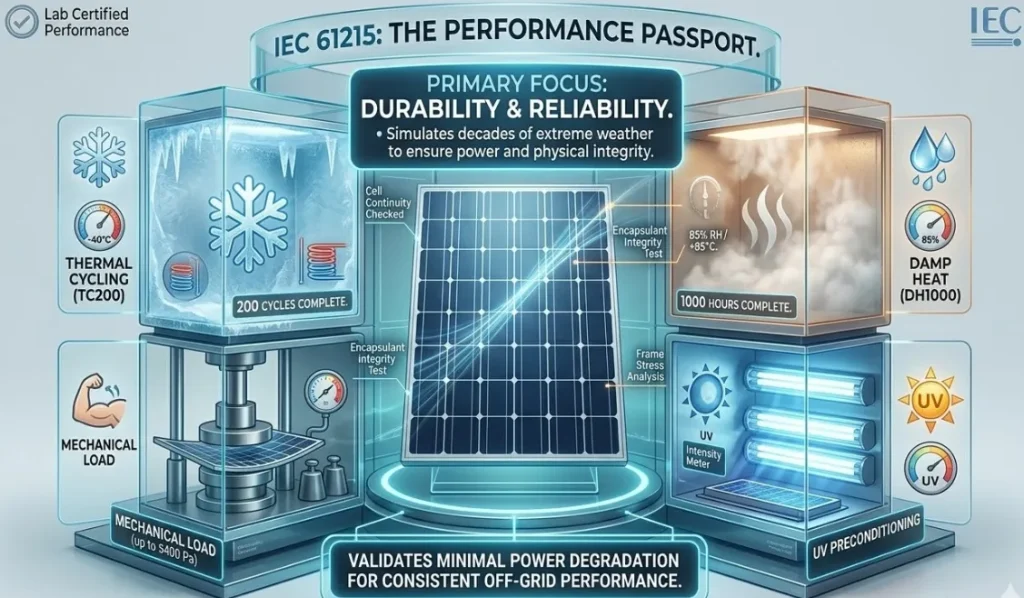
gave IEC 61215 (International Electrotechnical Commission) is widely regarded as the global “passport” for terrestrial photovoltaic (PV) modules. Its main purpose is to determine the module’s ability to withstand prolonged exposure to open air weather.
For Singold’s flexible and rigid off-grid modules, the IEC 61215 testing sequence includes:
Thermal cycling: Cycles between modules. -40°C and +85°C to simulate decadal seasonal temperature changes.
Damp Heat Test: 1,000 hours of exposure 85% humidity at 85°CChecking the integrity of lamination and cell protection.
Mechanical Load: Assessing the module’s resistance to wind, snow and ice (up to 5400 Pa for some hard lines).
UV Exposure: Ensuring that ETFE or glass surfaces do not yellow or degrade under intense solar radiation.
Practical Importance: When a module passes IEC 61215, it certifies that the product will not suffer from power failure in early life. For off-grid users, this means that the “100W” you buy today will still provide the closest rated power ten years from now, even in harsh tropical or alpine environments.
2. UL 61730: Standard for Safety and Fire Protection
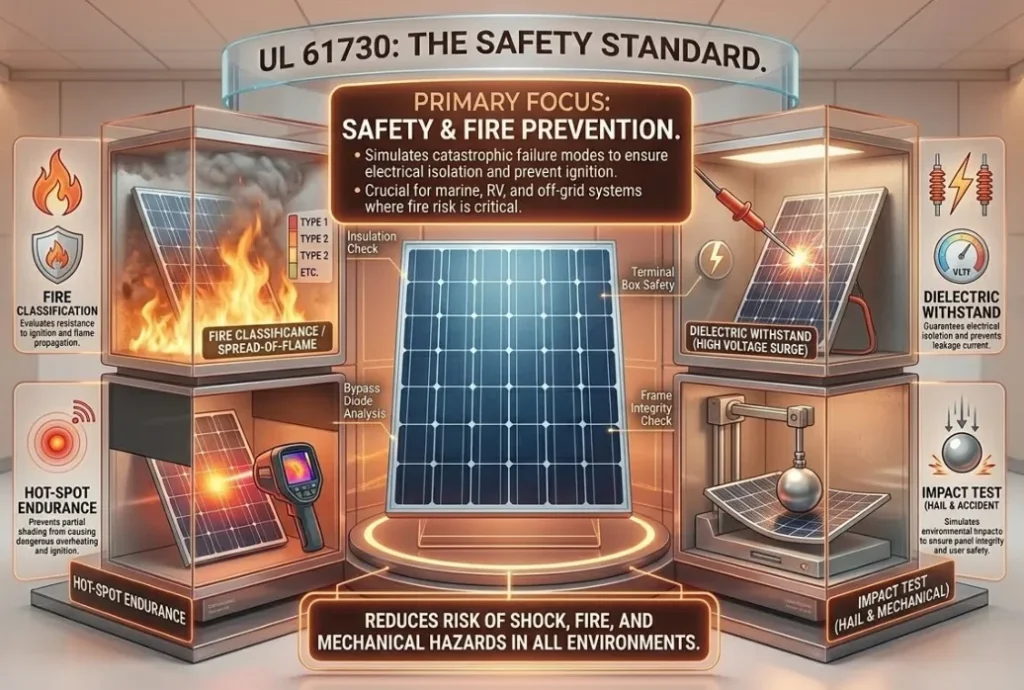
While IEC 61215 focuses on Whether the panel works, UL 61730 (Compliant with IEC 61730) focuses on Whether the panel is secure. In off-grid systems—where battery banks and flammable materials (such as RV roofs or log cabins) are often in close proximity—fire prevention is paramount.
UL 61730 evaluates the risk of electric shock, fire hazards and mechanical injury. Key tests include:
Fire Rating Test: Assessing the ability of the module to resist flame spread and ignition.
Dielectric Voltage – Withstand: Ensuring that the insulation can handle high voltage surges without “leaking”.
Hotspot Protection: To test the effectiveness of bypass diodes in preventing local overheating when cells are shaded.
Impact test: Hail or accidental impacts that can break the glass or compromise the protective layers of flexible panels.
Practical Importance: In the event of a system failure, UL 61730 certified panels are designed to fail “safely”. This significantly reduces the risk of an arc flash in a vehicle or building, which is a critical requirement for insurance compliance in North America and beyond.
echnical Deep Dive: IEC 61215 vs. UL 61730 Test Parameters
To better understand why dual certification is the standard for advanced off-grid modules, let’s look at the specific engineering stresses that apply to each standard. While IEC 61215 This ensures that the panel remains a high performing asset, UL 61730 This ensures that it does not become a liability.
| Test Category | IEC 61215 (Design and Quality) | UL 61730 (Safety and Security) | The purpose of engineering |
| Thermal stress | Thermal cycling (TC200): 200 cycles from -40°C to +85°C. | Thermal cycling (TC50): 50 cycles (focusing on safety integrity). | IEC tests for power loss. UL tests for insulation breakdown. |
| Moisture resistance | Damp Heat (DH1000): 1,000 hours at 85°C and 85% RH. | Moisture Freeze: Subzero temperatures followed by high humidity cycles. | Evaluates whether moisture causes cell corrosion (IEC) or electrical leakage (UL). |
| Mechanical strength | Static Load: Up to 5400 Pa (Front) / 2400 Pa (Rear). | Impact test: 51 mm steel ball drop or special “heal test”. | Ensures that the panel does not crack under ice (IEC) or break on impact (UL). |
| Electrical safety | Insulation test: Basic dielectric strength test. | Dielectric strength: 2x Max System Voltage + 1000V. | UL ensures that users are protected against high voltage shocks in wet conditions. |
| Fire performance | N/A (minimum attention to flammability). | Fire Type Classification: Propagation of flame and burning brand test. | For RV/marine use this is important to ensure the panel does not scratch the mounting surface. |
| Hot spot tolerance | Checks power degradation due to partial shading. | Determines whether a hot spot will cause the backsheet to melt or burn. | Prevents localized overheating in off-grid arrays from becoming a fire hazard. |
| Material integrity | UV Prerequisite: 15 kWh/m² UV radiation. | UV Resistance: Long-term safety testing of polymers and adhesives. | Ensures that the material is not brittle and does not expose live electrical parts. |
3. The Single Gold Journey: Achieving Dual Certification
Achieving both IEC 61215 and UL 61730 is not just paperwork. It is a fundamental redesign of the manufacturing process. At Singold, our engineering team spent months optimizing the material selection to meet these dual requirements.
Material innovation
Standard flexible panels often use PET, which can degrade over time and become flammable. To pass the rigorous UL fire test, Singold uses a high-grade ETFE (Ethylene Tetrafluoroethylene) And special flame retardant backsheets. These materials offer high thermal stability and self-extinguishing properties.
Quality control and EL testing
Each module passes. Electroluminescence (EL) testing Before and after the lamination process. This “X-ray” for solar panels detects microcracks invisible to the naked eye. Under the thermal cycling stress of IEC 61215, a microcrack can propagate into a hot spot. By finishing them at the factory, Singold ensures that our panels are fireproof throughout their lifetime.
Factory audit
Maintaining these certifications requires regular, unannounced audits by third-party bodies (such as TUV or UL). This ensures that every panel that rolls off the Singold line—whether it’s for a high-end RV or a rural electrification project—meets the exact safety standards of lab-tested samples.
4. Why dual certification is important for off-grid fire protection.
Off-grid systems are often “unattended”. If a solar panel at a remote weather station develops a hot spot due to a bad bypass diode design (a failure covered by UL 61730), there is no one there to extinguish the resulting fire.
combined Efficiency (IEC) with the Safety (UL)Singold provides a “double shield”:
Prevention of overheating: Advanced circuit design ensures that the shaded cells do not exceed safe temperature limits.
Electrical Integrity: High insulation prevents current leakage in the mounting frame, protecting users from electric shocks.
Mechanical flexibility: Our panels are designed to withstand the vibration of RV travel and the salt spray of marine use without losing their protective properties.
FAQ: Solr Certification Decoded
Q: If a panel has IEC 61215, do I still need UL 61730? A: Yes IEC 61215 proves that the panel is durable and will produce electricity. UL 61730 certifies that the panel is electrically safe and fire resistant. For residential or mobile installations, having both is the gold standard for security.
Q: Are flexible solar panels as safe as rigid glass panels? A: Only if they are certified. Many common flexible panels on the market lack UL 61730 certification. Singold’s certified flexible series uses high-tech polymers that pass the same fire and safety tests as toughened glass modules.
Q: How can I verify the manufacturer’s certification? A: Reputable manufacturers like Singold provide certificate numbers from testing labs (for example, TUV Rheinland or UL). You can verify them on the official websites of the certifying bodies.
Q: Does the certification affect the warranty? A: Absolutely. Certification is the basis of warranty. A manufacturer can only confidently offer a 10- or 25-year performance warranty if its modules have passed the accelerated aging tests required by IEC 61215.
The result
In an off-grid world, reliability is the only currency that matters. By investing in Dual IEC 61215 and UL 61730 certificationSingold Solar ensures that our partners and customers do not have to choose between performance and safety. Whether you’re powering a yacht in the Atlantic or a van in the outback, our certified modules provide peace of mind that your energy source is as safe as it is efficient.