
Technology Shift: Why PERC Is No Longer the Benchmark
For years, P-Type PERC was the “reliable workhorse” of the flexible solar market. However, as we enter 2026, PERC has hit its theoretical efficiency limit. enter N-Type TOPcon And BC (back contact) Technologies – The new vanguard of high-efficiency solar energy.
For professional integrators, the question is not just efficiency. This is about Levelized Cost of Energy (LCOE). Does the 15-20% price premium for Singold TF series modules translate to a 15-20% better bottom line? Let’s look at the data.
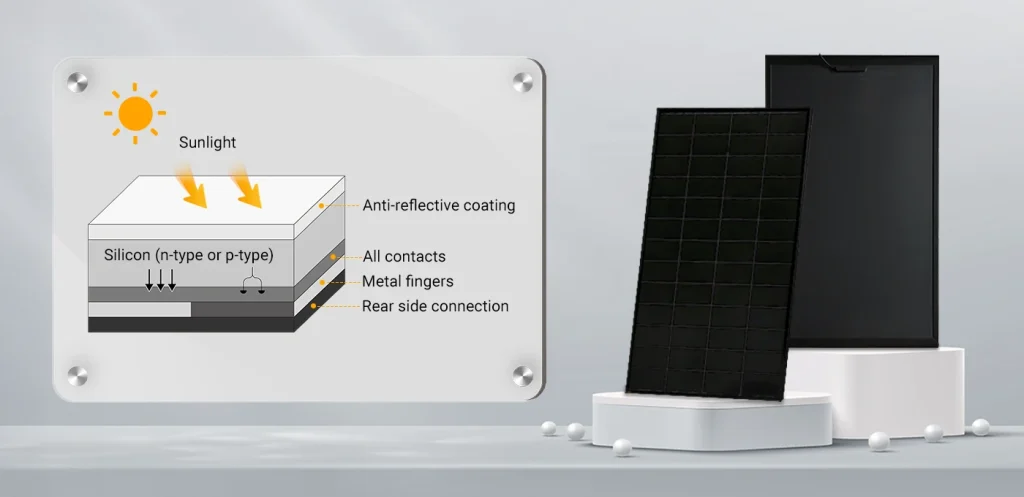
Technical Generation Analysis: PERC vs Singold TF Series (BC/TOPCon)
Based on our latest production benchmarks (ref Singold BC Series 25% efficiency standards), here’s how the races stack up:
| Feature | Legacy PERC (Flexible) | Singold TF Series (TOPCon) | Singold BC Series (Contact Back) |
| Cell performance | 20% – 21.5% | 23.5% – 24.5% | 25.0% |
| temperature coeff. | -0.39% / °C | -0.29% / °C | -0.28% / °C |
| 1st year demotion | 2.0% – 2.5% | 1.0% | 1.0% |
| Annual Decline | 0.55% | 0.40% | 0.35% |
| Aesthetics | Visible grid lines | Minimal lines | Pure black / no grid |
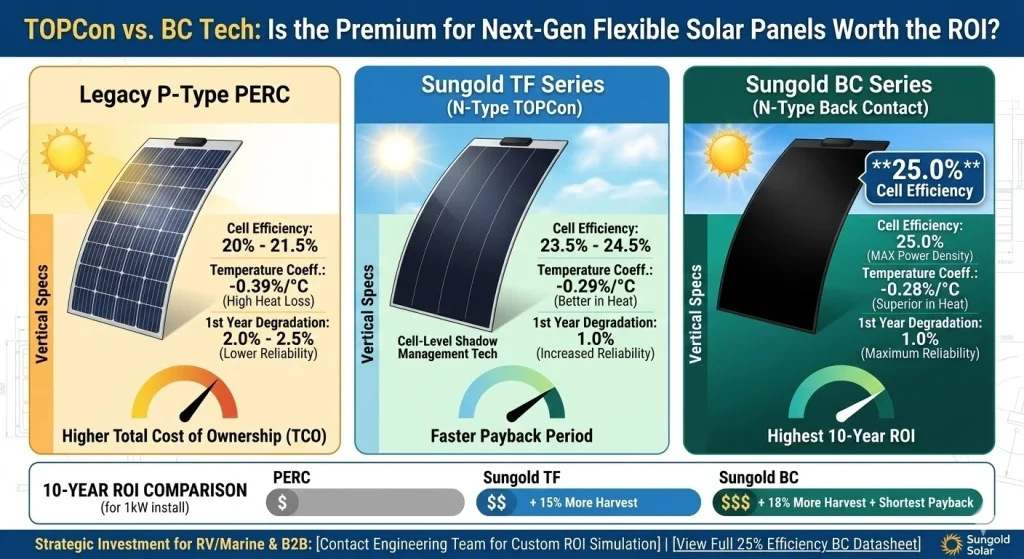
Calculating 10-year ROI: The true cost of “cheap” panels
To understand the ROI, we modeled a 1kW install in a high-insulation region (eg, California or Australia) over a 10-year period on a commercial fleet.
1. Comparison of Energy Harvesting
Because of Low temperature coefficient And Zero Light Induced Degradation (LID) Of the N-Type cells, Singold BC/TOPCon modules start generating power earlier in the morning and lose less in the heat of the afternoon.
PERC 10 Year Yield: ~14,200 kWh
Singold BC/TF 10-Year Yield: ~16,800 kWh (+18% increase)
2. Space constraints and installation labor
In B2B applications (RV roofs, yachts, or portable power stations), space is money.
To achieve the same power output Singold SGM2-BC-460Wyou’ll need about 25% more surface area than using standard PERC.
Result: Fewer panels to install, less wiring, and lower labor costs—effectively neutralizing the “premium” price of N-Type cells during initial setup.
3. Payment Period
Whereas a PERC system can be $200 cheaper for a smaller array. Singold TF Series Returns this difference within the first. 18-24 months By increasing energy harvesting and reducing battery stress (deep charging cycle).
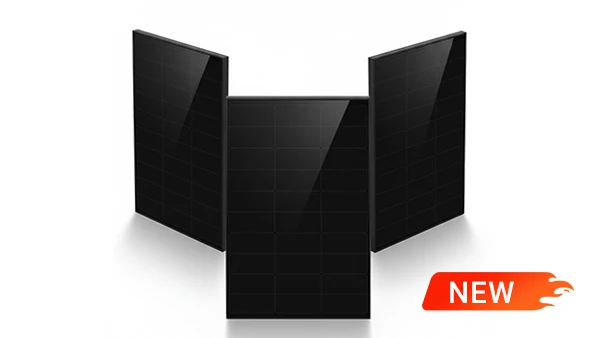
Outstanding high performance products
Singold’s 2026 lineup represents the pinnacle of N-Type integration:
SGM2-BC Series (Hard/Light): to highlight BC solar cells with 25% efficiency. Ideal for projects where maximum power density and a sleek, grid-free aesthetic are non-negotiable. (For example, SGM2-BC-460W)
SG-TF-M2 Series (Flexible): to use Cell Level Shadow Management Tech. Best for curved surfaces where partial shading (masts, AC units) would normally eliminate PERC performance. (For example, SG-TF-M2-200W)
PA621-BC Series: The ultimate lightweight solution, balancing 25% BC efficiency with only weight. 3.7KG to 6.4KG.
Frequently Asked Questions: Making the Procurement Decision
Q: Is TOPCon or BC better for the marine environment? A: BC (Back Contact) is often preferred for advanced marine applications because the absence of a metal grid on the front surface minimizes potential corrosion points and maximizes light absorption in murky coastal conditions.
Q: Why is N-Type (TOPCon/BC) more expensive than PERC? A: The manufacturing process includes more complex layering (tunnel oxide layers for TOPCon) and high-precision laser processing for BC. However, K Total cost of ownership (TCO) Less than 25 years due to longevity and high yield.
Q: Does Singold offer a warranty for these high performance modules? A: Yes, as seen in our specs, we offer up to 10 year warranty On BC models such as the PA621 and SGM2, significantly wear out common flex panels that often fail within 2-3 years.
Conclusion: Investment vs. Expenses
In the B2B solar market, PERC is becoming a budget expense, whereas TOPCon vs. BC Solar is a strategic investment.. If your project requires limited space, high heat exposure, or a 10+ year lifespan, the premium for Singold’s N-Type TF vs. BC series is simply not worth it—it’s the only way to ensure a competitive ROI.