
In the rapidly expanding solar market of 2026, the word “green” is often used loosely. Many consumers and businesses assume that any solar panel is inherently durable. However, when we look through the lens of a. Life Cycle Assessment (LCA)a stark contrast emerges between the various materials. The most important debate in the flexible solar sector today centers on this. LCA analysis of ETFE versus PET solar panels.
But Singold Solarour engineering philosophy is based on the belief that true decarbonisation is not just about generating clean energy – it’s about the total environmental cost of the hardware itself. The data reveals a clear fact: ETFE longevity is the only path to a net-zero future.
1. What is LCA? A “cradle-to-grave” approach
Oh Life Cycle Assessment (LCA) Measures a product’s environmental impact in four steps:
-
Raw Material Extraction: Silicon and polymer mining and energy used to refine them.
-
Manufacturing: Carbon emissions from the factory floor.
-
Use the steps: Clean energy generated over the life of the product.
-
End of Life: Ease of recycling versus landfill impacts.
The primary conflict in ETFE vs. PET Located in the “Usage Phase”. Although PET panels are cheap to manufacture, their high degradation rate makes them “disposable solar,” creating a cycle of waste that sabotages the consumer’s carbon reduction goals.
The PET Paradox: Low Cost, High Carbon Debt
PET (Polyethylene Terephthalate) is widely used in low-cost flexible panels. From an LCA perspective, the PET problem is:
“Disposable” cycle
A typical PET coated solar panel works for 2 to 3 years in a high UV environment. After this period, the material turns yellow (“browning effect”), cracks, and delaminates.
-
Energy Payback Time (EPBT): It takes about 1.5 to 2 years for a flexible panel to generate the energy required to meet its output.
-
Mathematics of Failure: If a PET panel fails at the 3-year mark, it has only been “carbon neutral” for about 18 months before becoming electronic waste (e-waste). You then have to buy another panel, doubling the carbon debt of your energy system.
ETFE Excellence: Engineering for decades, not seasons.
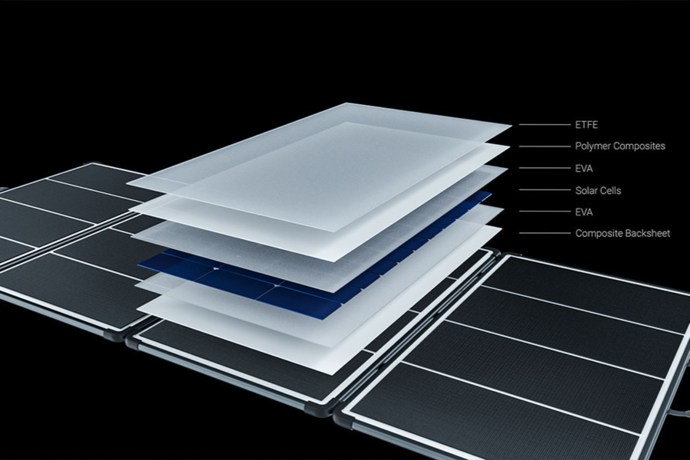
Virgin ETFE (Ethylene Tetrafluoroethylene) I am the gold standard for durability. LCA analysis of ETFE versus PET solar panels.
Longevity multiplier
A Singold ETFE module is designed to last. 10 to 15 years. Although the initial carbon footprint of ETFE manufacturing is slightly higher than that of PET due to the complexity of fluoropolymer processing, its longevity creates a huge environmental benefit.
-
High Carbon ROI: Over a 12-year period, you will need to manufacture, ship and ultimately dispose of it. Four Matches the energy output of PET panels. one Singold ETFE panel.
-
Reduction in e-waste: By choosing ETFE, you reduce the physical waste generated by your solar system by up to 75%.
4. Impact Quantification: LCA Comparison Table
| LCA Matric | Recycled PET panels | Singold Virgin ETFE Panel |
| Functional life span | 2-3 years | 10-15 years |
| Total energy harvest | ~450 kWh (before failure) | ~2,800+ kWh |
| Carbon Footprint per kWh | More (due to frequent change) | Very little |
| UV resistance | Bad (leads to chaos) | Excellent (Zero Yellowing) |
| Recyclability | Difficulty (adhesives deteriorate) | High (structural integrity remains) |
Why “longevity” is the only real decarbonization.
The most dangerous myth in renewable energy is that “cheaper and light” is always better. i LCA analysis of ETFE versus PET solar panelswe see that short-lived products actually increase the demand for raw material extraction and industrial processing.
Avoiding “greenwashing”.
When a company sells a PET panel as “sustainable” because it’s made from recycled plastic, they often ignore the fact that the product will end up in a landfill in 36 months. True sustainability is sustainability. By using virgin ETFE, Singold Solar ensures that the silicon cells, the most energy-intensive part of the panel, continue to function for their full potential lifespan.
Frequently Asked Questions: Understanding Your Solar Chart
Q: Does ETFE use more energy to produce than PET?
A: Initially, yes. However, the energy harvest of an ETFE panel over its lifetime is approx. 6 times more Compared to PET panels, significantly reduces the “carbon cost per watt hour”.
Q: Can ETFE be recycled?
A: Yes, since ETFE does not degrade as quickly as PET, the material can be more efficiently recovered and reprocessed at the end of its 10-year life cycle.
Q: Why is Singold Virgin Committed to ETFE?
A: Recycled ETFE may contain microscopic impurities that reduce the lifespan of the panel. To maximize Advantages of LCAwe use only virgin materials to guarantee the 10+ years of durability our customers expect.
Conclusion: Choose the panels that last.
When we perform deep. LCA analysis of ETFE versus PET solar panelsthe winner is clear. PET is a short-term financial solution that creates a long-term environmental problem. ETFE is a long-term engineering solution that provides real decarbonization.
But Singold SolarWe don’t just make panels for today’s travel. We build them for the next decade of sustainable energy. Invest in ETFE. Invest in the planet.