
Ever looked at the back of a phone charger and saw “500mA”, then looked at the spec sheet of a solar panel and saw “8.5A”? You are working on two different scales of the same thing: electric current. Understanding how to convert between milliamps (mA) and amps (A) is a fundamental skill for everyone from DIY electronics hobbyists to professional solar installers. This comprehensive guide will not only show you the simple formula but also explain it. why This change is critical to designing safe and efficient systems. We’ll cover practical examples and provide tools to make it easier.
What is the difference between milliamps and amps?
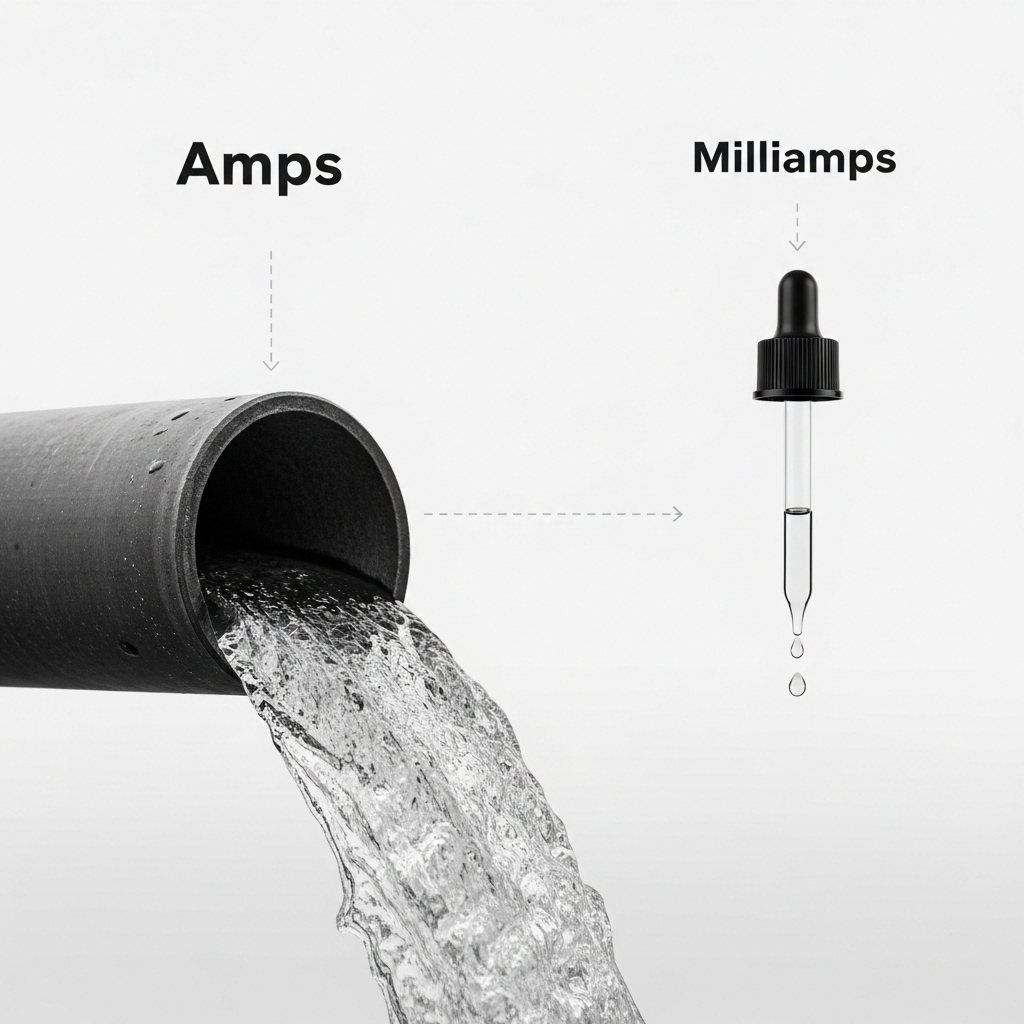
Think of electric current as water flowing through a pipe.
- Amps (A) are like Gallons per minute. It is the basic unit for measuring large, powerful flows of electricity. You will see amps used for large appliances, car batteries and of course solar panels.
- milliamps (mA) are like Drops per minute. A milliamp is simple 1/1000th of an amp. It is used to measure the very small currents that power sensitive electronics like sensors, LEDs, and components inside your smartphone.
Using the correct unit prevents you from writing small decimals (such as 0.05A) or large numbers (such as 50,000mA), making the specifications easier to read and understand.
How to convert Milliamps to Amps (mA to A)
This conversion is straightforward because you’re just moving the decimal point.
Principles: To convert milliamps to amps, Divide the milliamp value by 1,000.
Formula: Amps = Milliamps / 1000
Practical example: Your new smart home sensor has a current draw. 150mA. To understand its effect on your power system, you convert it to amps: 150 mA / 1000 = 0.15 A
It’s that simple.
How to convert amps to milliamps (A to mA)
To go the other way, you do the opposite.
Principles: To convert amps to milliamps, Multiply the amp value by 1,000.
Formula: Milliamps = Amps * 1000
Practical example: You need to choose a small fuse for the circuit. 0.5A. Fuses are often rated in milliamps. 0.5 A * 1000 = 500 mA
You will need a 500mA fuse.
Milliamps to Amps Conversion Calculator
For quick, error-free conversions, use our online calculator.
(This section will contain an interactive calculator tool on the original web page.)
[Online Calculator Tool Placeholder]
- Input field for mA/A
- Drop down to select the direction of conversion (mA to A or A to mA).
- “Convert” button
- Display field for the result
Quick conversion chart
Of course. Here is the conversion chart in a table format.
| Device Example | Current (mA) | Current (A) |
| LED Indicator Light | 20 mA | 0.02 A |
| Small Sensor | 100 mA | 0.1 A |
| USB 2.0 Port | 500 mA | 0.5 A |
| Smartphone (Fast Charging) | 1000 mA | 1.0 A |
| Tablet Charger | 2000 mA | 2.0 A |
| Large Solar Panel | 8500 mA | 8.5 A |
Why This Matters: Applying Conversions in Solar Systems
While the math is easy, the application in a solar power system is where precision becomes crucial. A simple conversion error can lead to inefficient systems, damaged components, or serious safety hazards. The basic formula is just the start.
Temperature Changes Everything
A solar panel’s current output is rated under standard test conditions (25°C or 77°F). But on a hot roof, that panel gets much hotter. As temperature rises, the resistance in your wiring increases, affecting the true current your system can handle.
- The Pain Point: Ignoring heat can lead to undersized wires that pose a fire risk and cause a significant drop in system efficiency.
- The Pro-Tip: Professionals use temperature correction factors outlined in the National Electrical Code (NEC) to select the right wire gauge. This ensures safety and performance in real-world conditions.
The 125% Safety Rule
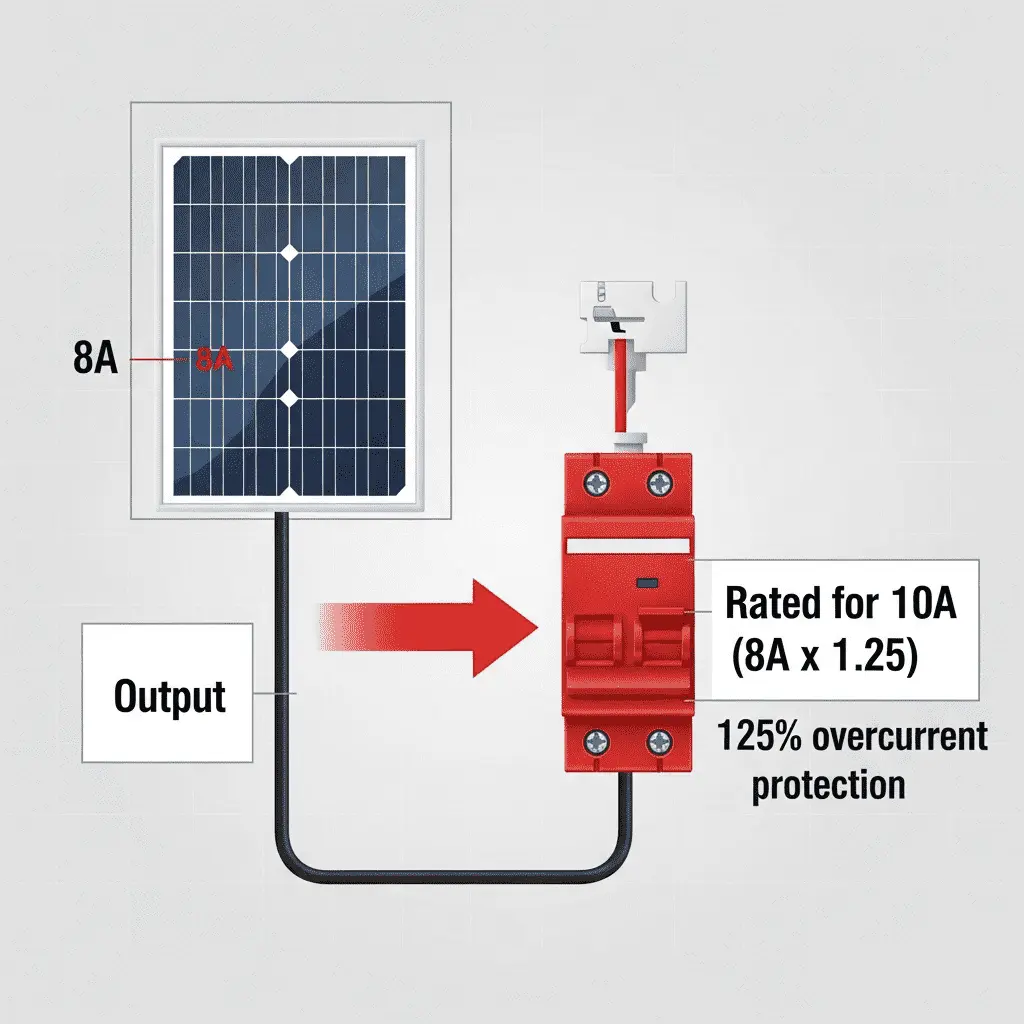
Solar circuits are considered “continuous loads.” The NEC mandates that your wires and overcurrent protection (fuses, breakers) must be sized to handle 125% of the expected maximum current.
- The Pain Point: Sizing your components for the exact calculated amperage leaves no safety margin, leading to nuisance tripping of breakers and overheating.
- The Pro-Tip: Always multiply your final calculated system amperage by 1.25 to determine the minimum rating for your wires and breakers. For a 10A system, you need components rated for at least
10A * 1.25 = 12.5A.
Parallel matching panels
No two solar panels are exactly alike. There are always slight manufacturing tolerances. When you connect panels in parallel, these small differences can cause current imbalances, reducing the overall power yield.
- Pain point: Simply adding up the rated current of each panel can give you an overestimate of your actual power output.
- Pro tip: For larger arrays, factor in a smaller tolerance percentage (as defined in UL 1703 standards) to get a more realistic expectation of total current. This ensures that your charge controller is sized correctly.
To learn more about system design, see our related articless.
Common pitfalls to avoid
- Neglecting temperature: Do not use standard condition current ratings for wire sizes in hot climates.
- Forgetting the 125% Rule: This is not a suggestion; This is an important safety requirement.
- Using the wrong multimeter: Always use a True-RMS Meter to accurately measure the current from an inverter.
- Mixing units: Double check each calculation to make sure you haven’t mixed up mA and A. A 20mA fuse is not the same as a 20A fuse!
- Disregarding battery characteristics: The output current of your solar array should not exceed the maximum charge current rating of the battery. Too much current can permanently damage your battery.
Frequently Asked Questions (FAQ)
Is 1 amp equal to 1000 milliamps? Yes, they are exactly the same value. 1A = 1000mA.
How many amps is 50 mA? To convert 50mA to amps, you divide by 1000. So, 50mA is 0.05A.
Why does my 100mA sensor read 0.098A on my meter? This is very common and is usually due to a combination of factors: the inherent accuracy tolerances of your meter (eg ±2%), minor voltage drops in the wiring, or the sensor’s own operational tolerances.
Final thoughts
Converting milliamps to amps is a simple but powerful skill. It’s the language of electricity that allows you to safely power your electronics and design efficient, reliable solar systems. By going beyond the basic formula and understanding real-world factors like temperature and safety regulations, you can ensure your projects last. High quality ingredients, such as a Singold Flexible Solar PanelProvide clear and accurate electrical specifications, giving you the reliable data you need for those important calculations.